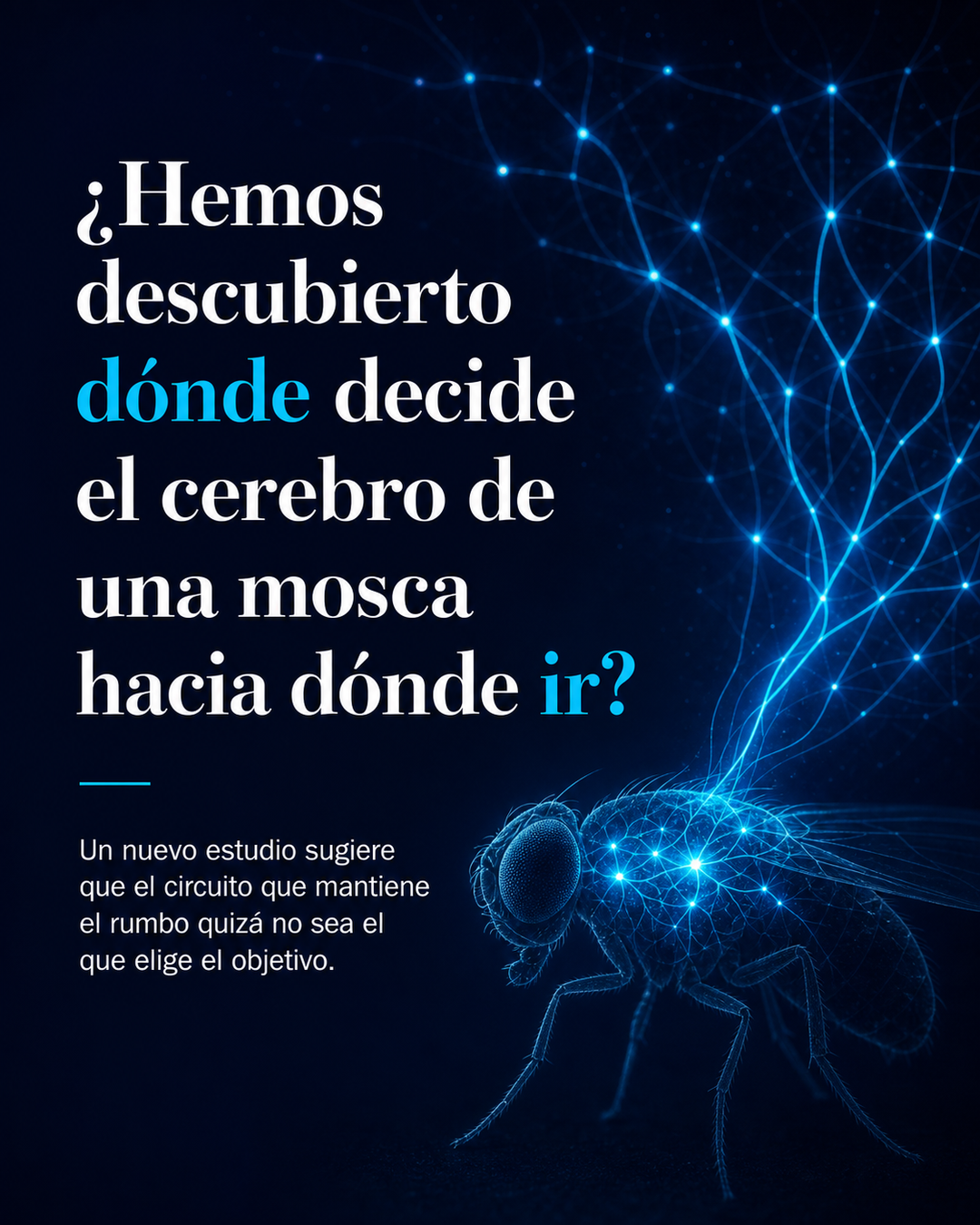
Neuroscience · Decision circuits · Preprint
How the fly holds a single goal: normalization, not selection, in Drosophila FC2
A fly can hold a direction without choosing it in the same circuit. Connectome geometry now separates those two jobs—and turns the distinction into a testable hypothesis.
What changed.
Why it matters.
The team decomposed FC2 feedback into a nearly uniform FB5A route, a smaller anti-local hDelta route and negligible direct recurrence, then tested whether that wiring could sustain winner-take-all dynamics.
Neuroscience often treats choosing a goal and stabilising it as one operation. This paper offers a circuit-level way to pull them apart and an experiment that could prove the interpretation wrong.
No living-fly confirmation yet. FB5A inhibition is unverified, and an hDelta selector at another gain remains possible.
Signal and judgment,
kept separate.
The structural result replicates in a second connectome, the model is checked against positive and negative controls, and the authors publish code, data and a falsifiable physiological prediction.
The ascendance gate is closed insufficient history. This dossier is not presented as proof of global momentum.
0 observation points across 0 days.
Observed on an unavailable date. The current assessment used —.
Compared with 0 papers of similar age, type and discipline.
A signal of attention, never a quality score or truth score.
Cadence: not available.
Not calculated yet: citation velocity, acceleration and a momentum score require more history. Missing values are not treated as zero.
The finding.
Without the hype.
The strongest result is structural: FC2 feedback is dominated by a nearly uniform FB5A route, with a smaller anti-local hDelta component and negligible direct FC2 recurrence. Across the connectome-constrained models tested, that geometry did not produce the full bistability expected of a within-FC2 ring-attractor winner-take-all. The proposal that FC2 normalises a goal selected upstream is a clear, testable interpretation—not a completed physiological demonstration.
The two proposed alternative routes contributed very little direct input to FC2.
Together they accounted for less than 0.2% of 78,193 FC2 input synapses; this is a structural exclusion, not a functional recording.
The tested models stayed below the authors’ no-latch threshold at reference gains.
The gap was about 24 degrees or less, below the 30-degree bound and far from the 114-degree bistable positive control.
Four FB5A cells reached every reconstructed FC2 neuron in the FlyWire brain.
The loop varied by about 5% across bearing, supporting near-uniform structural coverage rather than local neighbour coupling.
The smaller hDelta route was stronger across distant than nearby bearings.
Its estimated disynaptic weight rose from 37.8 in near bins to 94.7 in far bins, an anti-local rather than neighbour-coupling pattern.
Go deeper
only when you want to.
46 evidence links ground this dossier. Source quotations and full text are checked locally but are not redistributed.
01Study design and methods 7 mapped items
Connectome analysis and computational modelling, with structural replication in a second connectome
Several model families used connectome-constrained connectivity and were evaluated with seeded-basin tests and gain sweeps.
Positive and negative ring controls tested whether the bistability detector could distinguish local-excitation latching from global-only inhibition.
The team paired structural decomposition of the connectome with tests of bistability, feedforward sharpening and two-cue competition.
The principal material was one FlyWire brain containing 85 FC2 neurons, four FB5A neurons and hDelta/vDelta interneurons; hemibrain supplied an independent structural comparison.
Preferred bearing was recovered from FC2/PFL connectivity, while route geometry was measured with synapse-based disynaptic weights grouped by bearing distance.
The researchers repeated the structural uniformity and anti-local recurrence measurements in the independently reconstructed hemibrain.
The analysis used correlations, modulation, route ratios, concentration and thresholded basin-gap comparisons rather than a conventional sampling-based inferential framework.
02Claim map 5 claims
Measured FC2 feedback geometry is dominated by a bearing-uniform FB5A component, with a smaller anti-local hDelta component and negligible direct FC2 recurrence.
Synapse count is a structural proxy, and the decomposition was not numerically fitted to the previously reported physiological suppression curve.
Across the connectome-constrained model families tested, FC2 lacked the local recurrent excitation and full bistability expected of a within-FC2 ring-attractor winner-take-all.
An hDelta-mediated two-goal selector is bounded but not excluded because its biological gain is unknown and partial seed dependence appeared at higher modelled gains.
The authors interpret FC2 as normalising an externally set goal rather than selecting it, with FB5A as the leading uniform-normaliser candidate.
This is a falsifiable interpretation, not physiological confirmation; FB5A transmitter identity and net inhibitory action on FC2 remain unverified.
If FB5A is a global inhibitory normaliser, silencing it during two-goal imaging should preserve the competing-column ratio while increasing overall FC2 activity without reshaping angular tuning.
The prediction remains untested and could be confounded by the absence of a stable two-column readout, saturation or residual hDelta inhibition.
Connectivity nominates an hDeltaC-led recurrent network as the upstream substrate for the goal read by FC2 and excludes the hDeltaK–PFG attractor as a material source.
The nomination is structural, and the relevant hDeltaC functional driver line is reported as cell-type ambiguous.
03Limits and cautions 7 checks
A gain-dependent hDelta-mediated two-goal selector remains an open biological alternative.
The normaliser mechanism depends on inhibitory action that has not been physiologically verified for FB5A onto FC2.
An hDelta-mediated two-goal selector is not excluded because its biological gain is unmeasured and must be settled by physiology.
The distributed-substrate claim is structural, the in-silico model instantiates only FB5A, and the route decomposition is not fitted to the earlier suppression-distance curve.
There are no recordings of the FC2 selection mechanism in this paper; the core contribution is connectome decomposition and computational characterisation.
FB5A’s GABAergic label has low classifier confidence, and neither the GABAergic nor glutamatergic inhibitory route onto FC2 has been experimentally verified.
The proposed two-cue experiment may lack a stable two-column ratio, and saturation or remaining hDelta inhibition could confound its readout.
04Transparency 6 checks
The authors report a public analysis repository, committed result caches, tests and a versioned Zenodo release.
A competing-interests statement was not identified in the extracted full text.
The wiring data come from the public FlyWire and hemibrain connectomes.
A paper-specific funding statement was not identified in the extracted full text.
The computational materials and load-bearing result caches are reported as versioned and rerunnable.
No preregistration or registered analysis protocol was identified in the full paper.
Same science.
A different doorway.
This is the exact Spanish-language edition published by Hadox Research Labs and reconciled with this evidence dossier.
View the original Instagram post ↗Historical caption preserved; it predates this dossier URL.
Read the exact social caption
¿Hemos descubierto dónde decide el cerebro de una mosca hacia dónde ir? Un estudio propone que el circuito que mantiene el rumbo quizá no sea el que elige el objetivo. Hadox presenta una hipótesis falsable: una parte del cerebro podría escoger el objetivo y otra limitarse a mantenerlo estable. La ciencia detrás de la idea usa un conectoma —un mapa de conexiones neuronales— para estudiar las neuronas FC2 y FB5A. El resultado sugiere que mantener una decisión y tomarla podrían ser funciones distintas. La hipótesis aún debe confirmarse experimentalmente. 🔗 Paper: https://arxiv.org/abs/2607.18969 #HadoxScience #Neurociencia #Ciencia #Drosophila #BrainResearch